
Research | ACA Research
National Camps Census
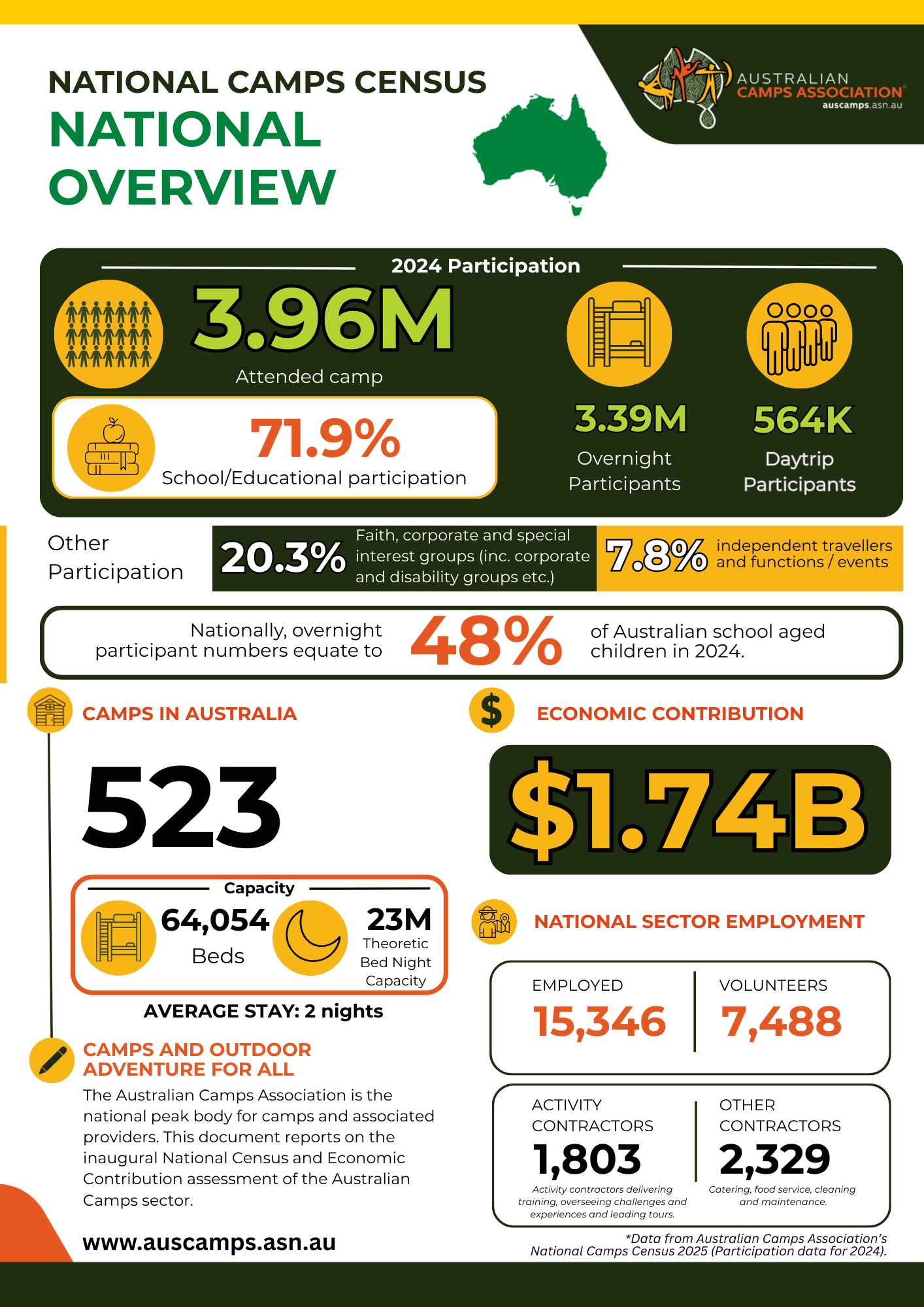 In 2025 the Australian Camps Association conducted the inaugural Camps Census. The Camps Census collected particpation data for the 2024 calendar year.
The ACA acknowledges the Victorian Goverment's support of this project.
Major Findings
- Camps establishments are ubiquitous around Australia. Victoria is home to the largest number of Australian Camps with around 34% of all businesses, with Queensland and New South Wales hosting a further 21% and 18% respectively.
- The majority of camps enterprises offer overnight venues for groups. Some also offer the opportunity for participants to camp (outdoors) on-site.
- Self-contained cabins are the type of accommodation provided in the greatest percentage of camps and while 42% of Australian camps offer only one form of accommodation, the remaining 58% of camps offer an average of 2.9 different types of accommodation. In 2024 there were an estimated 64,054 beds in Australian Camps with a theoretic capacity of 23.38 million bed nights and the indicative occupancy in 2024 was 28.9% of this capacity. Australian camps also offered 18,708 camping and caravan accommodation sites.
- Australian Camps tend to be highly specialised providers for educational institutions, with other common purpose groups as a signifcant secondary market. Estimated total participation at Australian Camps in 2024 was 3.959 million visits. School participation was by far the largest user segment contributing 70.2%, while special interest groups, faith camps, independent travellers (individuals and families), and functions/events contributed a further 26.0%.
- Overnight participants made up 3.395 million (85.8%) of total camps participants and there were 0.564 million daytrip participants. The overnight participants stayed 6.764 million nights, an average length of stay of 1.99 nights.
- The average number of participants in camp groups ranged from 23.5 in Queensland to 49.1 in the Australian Capital Territory.
- In 2024 the camps sector employed 15,346 people in full-time, part-time and casual roles for an estimated 6,344 full-time equivalent jobs.
- Additional to employees, Australian Camps were supported by volunteers and external contractors in 2024 including: An estimated 7,488 volunteers providing hands-on support roles such as ‘working bee’ teams, Committee and Board members, guest presenters, and instructors; 1,803 activity contractors delivering training, overseeing challenges and experiences, and leading tours; 2,329 other contractors engaged for catering, food service, cleaning and maintenance.
- The estimated economic contribution from camps in Australia in 2024 was $1.738 billion comprised of $688.2 million in direct contribution, $322.4 million in ancillary contribution and $727.8 million in indirect contribution.

National Census Infographic
National Census Infographic - ACT
National Census Infographic - NSW
National Census Infographic - NT
National Census Infographic - QLD
National Census Infographic - SA
National Census Infographic - TAS
National Census Infographic - VIC