
Ropes Courses
Australian Standard: AS 2316 Artificial Climbing Structures and Challenge Courses - Executive Summary for Camps and Activity Operators
In 2025, Standards Australia, finalised the review and development of the AS 2316 Artificial Climbing Structures and Challenge Courses Standard. This process has taken several years to complete with the Australian Camps Association (ACA) holding representation on the working committee to ensure that sector knowledge is included in the development of this Standard.
AS 2316.2.1:2025 (Design & Construction) and AS 2316.2.2:2025 (Operation & Inspection) set the minimum compliance requirements for flying foxes and challenge courses in Australia. This document is intended to highlight some of the key details the owners and operators need to make sure they address; however, it does not replace the need for owners and operators of Artificial Climbing Structures and Challenge Courses to know and understand the Standard.
Examples of elements covered in this standard (this is not an exhaustive list):
- Flying foxes or Zip lines
- Challenge ropes activities and elements*
- Self-belay and Assisted belay systems
- Including netted elements
- Giant swings
- Crate Stacking
- Quick fall activities
*Low Flying foxes and challenge courses with a free height of fall less the 2meters is addressed in AS 4685 Playground Safety
For the first time the standard also seeks to give guidance on;
- Benefit-risk assessments
- Universal design principles
- Unique Australian weather conditions
- Tree care when part of course design
Note: This is a summary only and The Australian Camps Association (ACA) encourages operators to make sure that they are across all of the requirements detailed in the standard.
Throughout the standard:
- ‘Shall’ indicates that a statement is mandatory
- ‘Should’ indicates a recommendation
- ‘May’ indicates the presence of an option
Documentation, records and evidence for audits
The following documentation is to be retained, present and maintained for the life of the of the Flying Fox or Challenge Course:
- Installation and design documentation
- Design verification and commissioning report.
- Operational manuals
- Safety Management System documents, benefit-risk assessments (generic, site-specific, dynamic).
- Rescue plans and evidence of rescue equipment availability and staff training.
- Documentation of any deviations from manufacturer’s intent.
- Training records for all competent persons, induction records and participant competency assessments.
- Inspection reports:
- Daily inspections and usage logs
- Operational inspection reports
- Comprehensive annual inspection reports
- Annual reports must list each element, components, condition, recommendations and ‘fit-for-use’ statement.
Mandatory inspection schedule
|
Inspection |
Frequency |
Conducted by |
|
Routine daily check |
Before each session. |
Competent person*. |
|
Operational inspection |
1–3 months. |
Competent inspector. |
|
Comprehensive annual inspection |
Yearly. |
Specialist inspector, includes arborist and pole report. |
|
Commissioning inspection |
New/major work. |
Competent design-aware inspector. |
*Competent person - a person who has acquired through training, qualifications or experience, or a combination of these, the knowledge and skills enabling that person to perform a specified task.
Failures and repairs:
Must be documented with repairs completed and documented by a component person.
Staff training & qualifications
Appendix F provides guidance on the on the minimum training, qualifications and experience that are required when undertaking the various roles.
Examples include
|
Title |
Roles |
Examples of qualifications |
|
Leader/ instructor |
· Set up · Daily routine inspection · Run sessions, under direction of a supervisor. |
SISOCHC003 - Lead challenge course sessions, high elements. OR Training and assessment aligned equivalent. |
|
Supervisor |
· Supervising the operation of activity · Verifying daily routine inspections · Performing dynamic benefit risk assessment · Rescues and Safety |
SIS0CH004 – Set up and supervise challenge course sessions, high elements OR Training and assessment aligned equivalent. |
|
Manager |
· Site operations · Staff management · Group management · Benefit-risk assessments · Record keeping |
|
Refer to www.training.gov.au for more information
Staff shall also complete an induction prior to commencing their role.
This induction shall include the following for staff and participants:
- Follow a documented procedure
- Include practical verification
- Document completion
Mandatory Closure and Local Weather Monitoring
Weather must be actively monitored on site, and operations must cease when conditions become unsafe or exceed preset trigger levels.
Local Weather Monitoring Requirements
The operator must:
- monitor weather at the activity location
- use at least two sources (e.g., Bureau radar + portable on-site wind meter)
- complete a dynamic risk assessment if conditions are changing unexpectedly
Mandatory Closure Triggers
Operations must stop immediately if any of the following occur:
Wind
- Sustained wind or gusts at or above the site’s defined limit for high elements
- Sudden gusting causing unexpected movement in trees, poles or elements
Lightning or Electrical Storm Activity
- Lightning detected within 10 km
- Thunderstorm approaching in visible line
- Storm cells tracking directly toward the site (via radar or local observation)
Extreme Weather
- Heat
- Cold
- Instructor ability to perform rescue compromised by heat illness risk
Closure Decision Authority
- Any competent instructor may pause the activity.
- Resumption requires supervisor or site manager approval, based on updated conditions and rescue viability.
- Closure decisions must prioritise rescue safety before program continuation.
Documentation
- All weather-related closures must be recorded in the daily activity log.
- Notes must include time, reason, weather readings (when applicable), and authorising staff member identification.
Reopening After Closure
Activities may only resume when:
- conditions have returned below closure limits
- rescue procedures remain viable in the new conditions
- dynamic risk assessment confirms safe operation
Emergency Rescue and Safety
The operator must maintain written rescue procedures tailored to each activity element and location.
Emergency plans must specify:
- The rescue plan must be available to staff during operation
- How a participant will be retrieved lowered, evacuated and medically supported
- Weather or wind trigger levels for ceasing operations
- Access for emergency vehicles
- Evacuation routes and assembly areas
- Communication systems for isolated or remote locations
- Rescue equipment must always be present and ready for use while the element/course is in use
- Staff trained to perform rescues & must be present at the element while in operation
Supervision Requirements Activities
Anyone supervising must be:
- trained in the specific activity they are supervising
- able to recognise unsafe actions before they become incidents
- confident to stop or pause the activity at any time
- able to perform or initiate the required rescue
Competency must be recorded, not assumed.
Must Be Active, Not Passive
Supervisors must:
- stay close enough to intervene immediately when needed
- actively monitor PPE fit, clips, rope systems and moving elements
- maintain a clear line of sight to participants on the activity
- manage distraction risks, including phones and non-program tasks
Reactive “watching from a distance” is not acceptable on aerial activities.
Rescue Must Be Possible from the Supervisor’s Position
A supervisor must be positioned where a rescue can start immediately. If the instructor cannot reach a stuck or distressed participant from their current location, they are not in a correct supervision position. The ability to rescue always outweighs convenience or visibility.
Ratio Guidelines
Ratios may change based on design, rescue method, element layout and participant needs.
Ratios should always have enough trained staff to manage connection, communication and rescue without delay.
At minimum, there must be one competent instructor for each active element, and more support staff added when:
- the group has mixed abilities or lower maturity
- the activity uses a haul team or ground helpers (like Giant Swing)
- multiple platforms or ground zones need supervising at the same time
- the environment makes rescue slower or more complex
- participants show anxiety, distraction, fatigue or additional support needs
Ratios should increase when the group becomes more difficult to manage, not decrease just because the participants are older or stronger. Rescue capability should always drive staffing decisions.
Match Cognitive Ability, Not Just Age
Consider both skill and maturity when deciding if a participant can:
- clip/unclip safely
- follow commands on the haul team (Giant Swing)
- manage self-belay or continuous belay systems
- climb without direct supervision on a platform
Crate Stack / Crate Climb Summary
Crate stacking is a high-challenge aerial activity because it combines fall hazards with falling-object risks. It is not a game or a low ropes activity and must use a harnessed belay at all times.
Core details
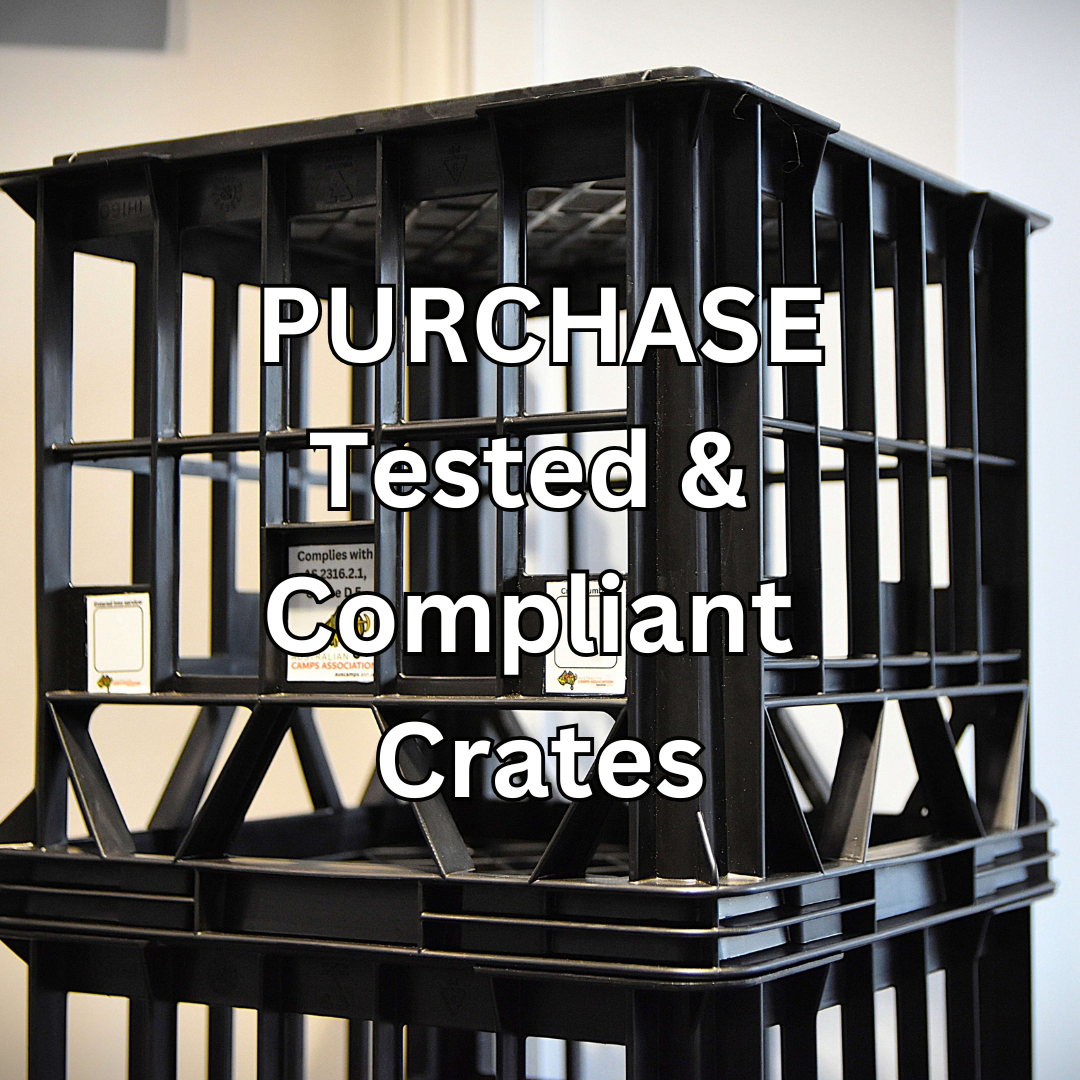
- The activity must be formally commissioned with documentation to prove suitability of crates and belay system.
- Crate suitability and load evidence must be documented (manufacturer rating, engineering verification, destructive test, or supplier declaration) in accordance with AS 2316.2.1.
- Annual independent comprehensive inspections must include the crate stack system, belay anchor, PPE, and fall-zone suitability.
- Safety Management System (SMS) must include crate-stack–specific risk assessment, rescue plan and retirement criteria for crates.
Equipment and Site Controls
|
Requirement |
Control Needed |
|
Crates must be tested and proven suitable* |
Crate specification, load rating, or verification retained on file. |
|
Impact zone must remain clear before lowering |
Instructor must not lower into crates. |
|
Anchors must be outside the fall zone |
No belay points inside crate impact area. |
|
Helmets mandatory |
Participants + anyone in fall zone. |
|
Auto-belays prohibited |
Must be staff-managed belay (risk of lowering onto debris). |
|
Crate retirement criteria documented |
UV cracks, fatigue, deformation, brittleness. |
*Load Tested crates are available for purchase through the Australian Camps Association.
 |
Giant Swing Activity Summary
Giant Swings are treated as high-challenge with group-powered haul systems.
Core Details
- Commissioned installation with documentation confirming compliance with AS 2316.2.1 (engineering design + proof of construction)
- Swing system must be independently inspected annually, including haul system, poles/trees, harness connections and anchors
- Safety Management System must include swing-specific risk controls, rescue plan, and wind/severe weather triggers
Equipment and Site Controls
|
Requirement |
Expected Control |
|
No-go zone around the swing path |
Must be barricaded or fenced to stop entry |
|
Ladder must have a defined home position |
Outside swing arc; must not remain in path |
|
Haul team surface clear of obstacles and well defined |
Prevent trips and falls |
|
Release mechanism must be appropriate to participant capability |
Quick-release device, manageable load handle |
|
Remote lowering method required |
For stalled, stuck or distressed participant |
|
Hardware inaccessible to participants |
Pulleys, blocks, lifting points must be out of reach |
Flying Foxes and Challenge Ropes Course activities create amazing memories and real learning moments, but they also come with moving parts, strong forces and unique safety challenges. If your camp or organisation runs crate stack, flying foxes, giant swings or ropes elements, buying AS 2316.2.1 and AS 2316.2.2 is one of the best things you can do to make sure you’re running them safely and confidently. The Standard gives you clear guidance, practical expectations and the detail you need to make decisions that protect your staff, your participants and your whole operation. It has been designed for our sector with input from our sector.
Let’s Lift the Standard Together
ACA encourages all members and sector colleagues operating Flying foxes and challenge ropes activities to purchase the Standard and apply it across their sites. It’s a practical investment that lifts the quality, safety and reputation of the outdoor sector.
For questions or help implementing the Standard, contact Dwight Hulme, ACA Membership & Partnerships Manager via email or contact the ACA Office on 03 9863 6822. We’re here to support every camp on the journey to a safer, more sustainable adventure.
