
Member Area Resources - Beds and Bunks
Bunk Bed Assessment Checklist
Updated August 2026
Also on this page:
- Bunk Bed Safety Assessment
- Bunk Bed Checklist
See also: ACA Executive Summary: AS/NZS 4220:2026 Bunk Beds and other Elevated Beds
Bunk Bed Safety Assessment
Updated for AS/NZS 4220:2026 Bunk Beds and Other Elevated Beds
Introduction
Bunk beds are a central part of many camps, outdoor education centres, school camps, holiday parks, hostels and group accommodation facilities. While they provide efficient sleeping arrangements, injuries resulting from falls, entrapment and unsafe access systems remain a significant risk.
AS/NZS 4220:2026 Bunk Beds and Other Elevated Beds is the latest Australian/New Zealand Standard and represents the most significant update to bunk bed safety requirements in more than a decade. The Standard introduces new requirements for commercial-use bunks, access systems, structural strength, mattress ventilation, storage compartments, product labelling and user safety information.
The Australian Camps Association (ACA) was proud to represent the camping and outdoor accommodation sector as a member of the Standards Australia Working Group responsible for revising AS/NZS 4220. ACA believes the changes introduced in the 2026 edition will further improve bunk bed safety and provide greater confidence for camp operators purchasing bunk beds from manufacturers claiming compliance with the Standard.
Key Safety Risks
The primary hazards associated with bunk beds remain:
- Falls from elevated sleeping surfaces.
- Entrapment of heads, limbs or fingers.
- Strangulation resulting from dangerous gaps or snag points.
- Unsafe ladders and access systems.
- Structural failure resulting from inadequate strength or maintenance.
- Injuries caused by inappropriate mattress selection.
- Contact with ceiling fans, light fittings or room fixtures.
Commercial Durability
AS/NZS 4220:2026 introduces two performance classifications:
Level 1
Normal domestic use for occupants up to approximately 75 kg.
Level 2
Severe domestic or commercial use for occupants up to approximately 110 kg.
Level 2 beds are designed for occupants up to approximately 110kg and are intended for higher-use environments such as camps and hostels.
AFRDI 152 (Rated Load) Commercial are designed for occupants up to approximately 135kg and are also intended for higher-use environments such as camps and hostels.
ACA strongly recommends that camps, hostels, outdoor education centres and other group accommodation providers purchase bunk beds certified to Level 2.
Bunk Height
The new Standard permits:
- Maximum height of 1500 mm from floor to mattress base for conventional upper bunks.
- Maximum height of 1600 mm for elevated beds where furniture, storage or usable space exists below.
Regardless of height, all elevated beds with mattress bases 700 mm or more above the floor must have compliant guardrails.
Mattress Bases
Mattress support systems must:
- Be securely fixed.
- Prevent movement greater than 5 mm under test loading.
- Include ventilation openings.
- Provide a minimum of 70 cm² ventilation area across at least four locations.
Guardrails
Guardrails are the primary defence against falls.
Requirements include:
- Guardrails on all exposed sides.
- Minimum guardrail height of 360 mm above mattress base.
- Mattress surface must remain at least 160 mm below the top edge of the guardrail.
- Guardrails removable only with tools.
- No dangerous openings or entrapment hazards.
ACA continues to encourage a greater margin of safety where practical.
Access Systems
AS/NZS 4220:2026 significantly expands access requirements.
Access devices may include:
- Ladders
- Step ladders
- Stairways
- Access platforms
Requirements include:
- Minimum climbing opening width of 300 mm.
- Maximum opening width of 400 mm (Level 1) or 500 mm (Level 2).
- Handholds or transition grips.
- Compliant tread spacing.
- Secure attachment.
- No entrapment hazards around access systems.
Storage Compartments
A major new requirement in AS/NZS 4220:2026 addresses enclosed storage compartments incorporated into bunk beds.
Storage areas above specified dimensions must:
- Include ventilation openings.
- Avoid automatic locking mechanisms unless releasable from inside.
- Limit latching forces.
- Prevent entrapment and suffocation hazards.
Protrusions, Sharp Edges and Pinch Points
The Standard requires:
- No protrusions greater than 5 mm that could snag clothing.
- No sharp edges or sharp points.
- Protection from shear and squeeze hazards around moving components and lids.
- Flush, recessed or domed fasteners.
Entrapment Hazards
Dangerous openings continue to be a leading cause of fatal incidents.
AS/NZS 4220:2026 specifies detailed entrapment requirements addressing:
- Head entrapment.
- Neck entrapment.
- Finger entrapment.
- Limb entrapment.
- Reducing gaps and wedge-shaped openings.
Mattresses should fit snugly and not create hazardous gaps between the mattress and bed frame.
Positioning of Bunks
Bunks should be positioned to minimise secondary injury risks.
The area surrounding bunks should be free of:
- Hooks
- Shelving edges
- Light fittings
- Exposed furniture corners
- Blind cords
- Curtain cords
Bunks should not be located near windows where practicable.
Mandatory Warnings
The following warning is required under AS/NZS 4220:2026:
WARNING — TOP BUNKS AND ELEVATED BEDS ARE DANGEROUS AND ARE NOT RECOMMENDED FOR CHILDREN UNDER THE AGE OF 9.
Falls from elevated beds can be fatal and deaths have occurred where children have fallen from elevated beds. This is relevant for all ages. The risk is greater for younger children.
The following warning must also be provided:
WARNING — The upper bunk must be more than 2 m from any ceiling fan (measured from the closest part of the bunk to the outer tip of the ceiling fan blades).
Recommended User Information
Camp inductions, booking information and accommodation briefings should advise guests that:
- Children under 9 years should not use upper bunks.
- Top bunks should not be used by persons affected by alcohol, drugs or medication.
- Bunks are not play equipment.
- Climbing should only occur using designated access devices.
- Defects must be reported immediately.
- Upper bunks must remain clear of ceiling fans.
- Only mattresses recommended by the manufacturer should be used.
Maintenance
AS/NZS 4220:2026 requires users to periodically inspect bunk beds to ensure:
- Guardrails remain secure.
- Access devices remain secure.
- Structural components are maintained.
- Connectors and fasteners remain tight.
ACA recommends incorporating bunk inspections into routine accommodation inspections and maintenance schedules.
Bunk Bed Checklist
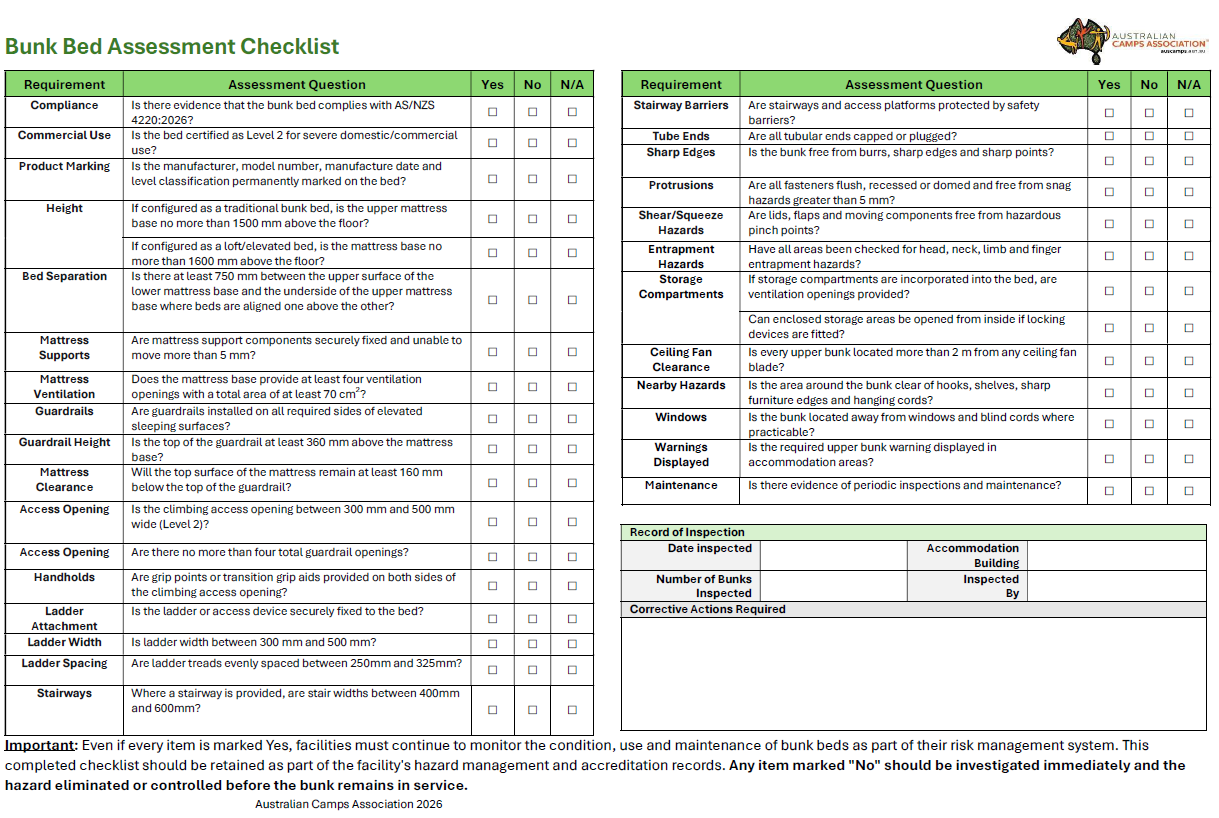
Important
Even if every item is marked Yes, facilities must continue to monitor the condition, use and maintenance of bunk beds as part of their risk management system.
This completed checklist should be retained as part of the facility's hazard management and accreditation records.
Any item marked "No" should be investigated immediately and the hazard eliminated or controlled before the bunk remains in service.
